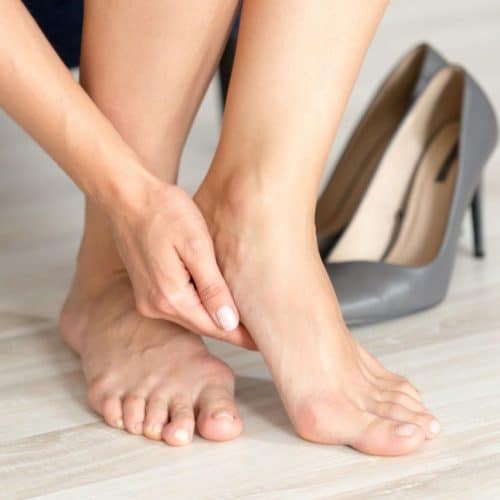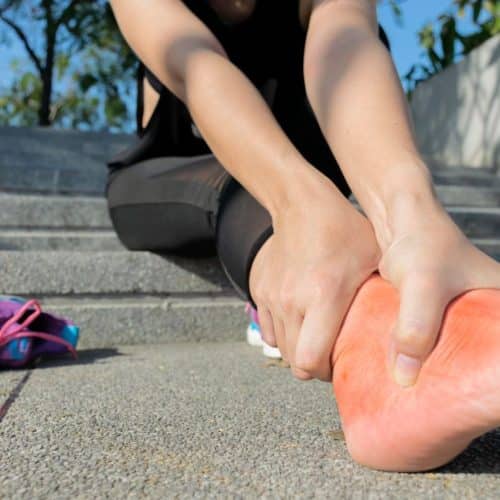


Turf toe is a sprain of the ligament underneath the big toe joint, resulting from injury during sporting activities. The injury usually results when the big toe is forcibly bent up into hyperextension.
The condition can be caused from either jamming the toe, or repetitive injury from pushing off when running or jumping. When running or jumping, each subsequent step is started by raising the heel and moving body weight forward by “pushing off” the big toe.
Injury can result during this “pushing off” phase if the big toe “gets stuck” and remains flat on the ground, causing bodyweight to go forward and so bending the toe up past its normal range of motion.
This injury is most commonly reported in football players who play on artificial turf, hence the term “turf toe.” Artificial turf is a harder surface than grass and does not have much “give” when force is applied. Therefore the toe is more likely to get stuck or jammed.
However, turf toe still occurs in a wide range of sports such as soccer, basketball, wrestling, gymnastics and dance.
Causes of Turf Toe (Painful Big Toe):
- Sudden upward bending of the big toe causing a sprain or tear to the ligaments underneath (i.e If you are tackled or fall forward and the toe stays flat, causing hyperextension of the toe).
- Hyperextension, repeated over time causing eventual wearing and spraining of the ligament under the big toe.
- Non-supportive flexible soled shoes.
- Increased range of motion in the ankle joint.
Symptoms of Turf Toe (Painful Big Toe):
- Swelling and pain around the big toe joint.
- Limited joint range of motion of the big toe.
- Pain and tenderness when bending or pulling the toe upwards, typically lasting for two to three weeks.
- Sudden onset of signs and symptoms that intensify over a 24-hour period if direct trauma is the cause.
- Gradual onset of signs and symptoms that progress over time will be evident if repetitive trauma is the cause.
- If the injury is great enough a “pop” can be felt. Usually the entire joint is involved, and toe movement is limited.
Diagnosis for Turf Toe (Painful Big Toe):
- To diagnose turf toe, the podiatrist will ask a series of questions about how the injury occurred, type of footwear worn, surface played on, sport played etc. to better understand the presenting condition.
- The podiatrist will then examine your foot, palpating for areas of tenderness and noting any swelling compared to the other foot.
- Range of motion of the joint will be examined.
- X-ray may be requested to rule out any other damage or fracture. Bone scan, CT scan, or MRI may be required in some circumstances.
Turf toe once diagnosed is then graded from 1 to 3 depending of severity.
- Grade 1. The ligament on the base of the big toe has been stretched causing pin-point tenderness and mild swelling.
- Grade 2. A partial tearing of the ligament with more diffused tenderness, moderate swelling, and bruising. Range of motion is limited and painful.
- Grade 3. The plantar ligament is completely torn causing severe tenderness, swelling, and bruising. It is difficult and painful to move the big toe.
Treatment for Turf Toe (Painful Big Toe):
Nonsurgical Treatment
Grade 1.
- Rest, ice, compression, and elevation (RICE) protocol initially for all grading’s of turf toe.
- Taping or protective brace is worn to restrict bending motion.
- Non-steroidal anti-inflammatory medications to relieve pain and swelling.
- Stiffed soled sports shoe.
- Non-flexible rocker soled shoe is the most appropriate choice of footwear for casual wear while recovering.
- Orthotics, such as a thin graphite shoe insert, will restrict bending of the big toe joint and reduce stress on the plantar plate.
- Pain is usually tolerable and sports participation can continue.
Grade 2.
- Immobilisation of the big toe, using crutches, moon boot or plaster cast for up to a week.
- Afterwards, these injuries are managed with a taping regime and the grade 1 treatments discussed above.
- In most cases, grade 2 injuries require 3 to 14 days of rest before returning to physical activity.
Grade 3.
- Immobilisation for a period of 6-8 weeks. Moon boot or plaster cast to keep the big toe in a partially pointed down position.
- As the injury heals, treatment will follow that of a grade 2 and then to grade 1 protocol.
- After the toe has been offloaded and healed, podiatry review may be required to re-establish joint range of motion, strength, and conditioning of the injured toe.
Surgical Treatment
If symptoms of pain and dysfunction persist surgery is generally necessary.
The surgical procedure will vary according to the injury. The aim of surgery is to repair the soft tissues and restore the big toe joint motion, restoring normal function.
Prevention of Turf Toe (Painful Big Toe):
- Shoes with better support and a stiffer sole to help keep the big toe joint from excessive bending.
- Custom made foot orthoses that your podiatrist can prescribe for you to offload pressure to this area and correct any abnormalities in gait that can lead to further injury
Well Heeled Podiatry is trained and skilled with treating injuries occurring below the knee, and can help treat and prevent a painful big toe joint.